Skip to main content




Wildfire resources: If you are impacted by the wildfires in eastern Washington, see WSAC's wildfire resources. If you have questions or concerns regarding RCG as a result of the wildfires, please contact RegionalChallengeGrant@wsac.wa.gov.
Moving the Attainment Needle
Washington’s north star for educational attainment is 70 percent of adults with a credential beyond high school (including certificates and apprenticeships).
Though there are signs of improvement across the state, we remain 8 percentage points below this goal. At the same time, direct-to-college enrollment among Washington’s high school graduates still hasn’t recovered from the pandemic, dropping from 59 percent for the Class of 2019 to 53 percent for the Class of 2024. (Sources: WSAC Attainment and SAP dashboards.)
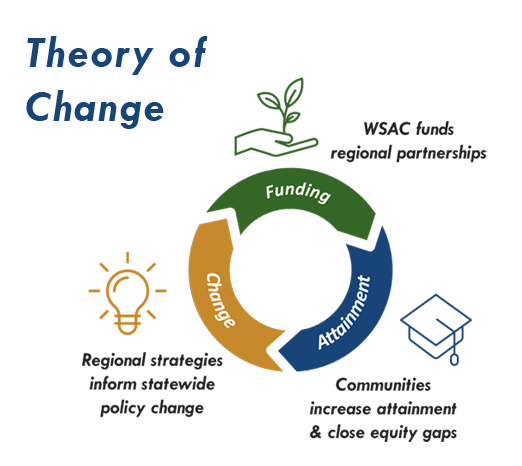
WSAC understands that our greatest chance of yielding systemic change in education requires that we center and uplift the strengths of communities working together to improve educational outcomes for their students. Passed in 2022 with bipartisan support, Senate Bill 5789 established the Regional Challenge Grant (RCG). RCG supports the formation and growth of cross-sector partnerships that are committed to increasing educational attainment in their communities.
In recognition of the need for culturally relevant and regionally responsive solutions, our goal is to empower regional partnerships that invest in communities so that structural barriers no longer impede educational access and outcomes, especially for students of color, students from low-income backgrounds, English-language learners, students with disabilities, students experiencing homelessness, and students in foster care.
Since passing SB 5789 in 2022, RCG has supported 13 cross-sector partnerships across 16 counties in Washington. These partnerships include more than 150 organizations invested in increasing postsecondary attainment. Each partnership is using self-identified, place-based strategies to achieve the systems change goal and serve their community of learners. WSAC has committed just over $20 million in funding to place-based partnerships.
During the 2025-2027 biennium session, all ongoing funding to the Regional Challenge Grant was eliminated. Partnership investments continue through June 2027 or June 2028, depending on the start date of their funded work.
Community-Led Impact
 |
 |
 |
| WSAC’s Regional Partnerships filed FAFSA applications 16 percentage points higher than students at non-served schools in the 2024-25 AY. | For FAFSA completion, nine of the top 20 school districts were supported by the Regional Challenge Grant in the 2025-26 AY, including Riverside (90% completion), Methow Valley (84%), Toppenish (83%), Nine Mile Falls (77%), Seattle Public Schools (77%), Granger (76%) and College Place (75%) school districts. | Of the high school seniors supported by RCG-funded FAFSA initiatives, 45% are free and reduced-price lunch eligible, 31% are Hispanic/Latinx, and 15% are English Language Learners. |
WSAC's Regional Partnerships in Washington State by County

City of Seattle Postsecondary Success Network
City of Seattle Postsecondary Success Network
Partners: El Centro de la Raza, Empowering Youth & Family Outreach, Mentoring Urban Students & Teens, Project Baldwin, Project Maya, Seattle Public Schools, Right Standing Solutions, Scholar Fund, Brotherhood Initiative, City of Seattle Department of Education & Early Learning, Seattle Promise, Seattle Youth Employment Program, and Sisterhood Initiative
Notable for its billion-dollar tech conglomerates, Seattle is easily becoming one of the fastest-growing cities in the country. While income gaps widen for Black, Indigenous, and People of Color (BIPOC), so does access to quality postsecondary resources. Despite this, BIPOC students have a strong desire to go to college, and their families are strongly supportive of their college-going. Seattle has a wealth of community-based organizations engaging specific student populations. Since 2018, Seattle Promise has streamlined enrollment for Seattle Public Schools students to Seattle Colleges. While current infrastructure does exist, there is an opportunity to coordinate services among service providers and a need to support retention for BIPOC students once enrolled. The Postsecondary Success Network was founded to create transparency around the work partners are doing individually and collectively, identify opportunities for cross-partner collaboration, and strengthen the collective impact to improve retention for BIPOC students.
The partnership believes that enabling postsecondary enrollment and completion for Seattle BIPOC students requires engagement with both students and student-facing professionals. Culturally specific mentorship enables students to reinterpret their marginalized identities as cultural assets, while also building key college and career readiness skills. Paid career exploration opportunities allow students to identify their professional interests, gain marketable skills, and build their career network. Professional development for educators builds adult knowledge of culturally specific and sustainable approaches to college and career advising, and strategies for engaging families in college preparation.
Cornerstone
Cornerstone
Partners: Bethel Church, Boys and Girls Club, Chehalis Foundation, Summit Center for Child Development, United Way of Lewis County, Centralia College, Chehalis School District, and Baker Evaluation Research Consulting Group
For over a decade, Chehalis School District and Chehalis Foundation have collaborated on the Student Achievement Initiative (SAI), a multi-year effort credited for increasing high school graduation rates, remarkably from 77 percent in 2010 to 97.6 percent in 2024. As many graduates decide to stay local, a partnership with Centralia College has also created a warm handoff for enrollment at the two-year institution. At the same time, English learners (EL) and low-income students continue to be underrepresented in these outcomes, especially given that Chehalis and neighboring Centralia are home to approximately 15 percent and 20 percent Hispanic or Latino individuals, respectively. These same statistics also mirror the population of low-income residents in both locations. For these longtime partner organizations, there is an opportunity to engage and guide underrepresented students and their families from the onset of education toward graduation and postsecondary success.
The Cornerstone partnership believes supporting whole families yields success for K-12 and beyond. When parents thrive, whole families thrive too. To this end, Cornerstone cultivates strong relationships with low-income students, EL, and their families, blending case management and high-quality engagement opportunities to lay the groundwork for postsecondary preparation. While the impacts of Cornerstone on postsecondary enrollment and completion for young students may not be easily seen for many years, effective early learning develops skills needed to persist in elementary and secondary education. A dual generation approach focuses on the success of whole family systems, propelling youth into the SAI orbit and accompanying parents on their own unfinished educational journeys.
ELEVATE
ELEVATE (Empowering Learners to Excel through Vocation Advancement, Training, and Education)
Partners: Evergreen Goodwill of Northwest Washington (EGNW), Latino Educational Training Institute (LETI), and Everett Community College (EvCC)
North of Seattle, in Everett, data from the 2022-23 academic year shows that 47 percent of the student population was 25 years old or older, excluding programs that involve high school dual enrollment. Many individuals have years of experience in the military, workplace, community, family settings, and academic institutions outside of the U.S. While some adults may not be currently enrolled in an institution of higher education, many adult learners are gaining job-specific skills through adult basic education classes at local community-based organizations. A unique challenge for the region is recognizing how this learning can count toward postsecondary credentials.
ELEVATE builds infrastructure in Snohomish County to support adult learners, so that they can earn postsecondary credentials that lead to sustainable wage jobs. This infrastructure is three-pronged, aiming to support adult learners with their academic, social and emotional, and basic needs. First, growing Academic Credit for Prior Learning (ACPL) will enable more adult learners to be awarded academic credits toward a degree or certificate at EvCC for courses taken at local community-based organizations. This also means supporting students who have completed credentials in countries outside of the U.S. in getting their credentials translated, evaluated, and transferred to EvCC. Second, the partnership works to increase the sense of belonging for adult learners on EvCC’s campus through expanding the support services partner organizations provide and by creating a dedicated space for adult learners on campus. Third, ELEVATE supports learners’ basic needs through the creation of the ELEVATE Completion Fund, which provides monthly financial support for basic needs for a smaller cohort of ELEVATE learners. In combination with the ELEVATE Completion Fund, the partnership provides emergency basic needs funding to help prevent stop-outs due to financial constraints. By targeting all three needs, the partnership believes more adult learners in the region will enroll, persist, and complete credentials that increase their economic mobility.
Future Horizons
Future Horizons: Building Unity Through Tribal Partnerships & Pathways in Rural Healthcare Systems
Partners: Spokane Colleges, WSU Native American Health Sciences, Coeur d'Alene Tribe, Confederated Tribes of the Colville Reservation, Confederated Tribes and Bands of the Yakama Nation, Kalispel Tribe of Indians, Spokane Tribe of Indians, Providence Medical Group, and the Nez Perce Tribe.
62 percent of Washingtonians have a postsecondary credential, but only 26 percent of Native American Indian or Alaska Native people in Washington have one. Few Native American students complete health science degree programs, and no institution of higher education in the US has a clinical simulation center designed for and by Native Americans. Simply put, more infrastructure is necessary to support Native students. Interrupting this cycle means delivering a health science curriculum that is built with Native voices and increases a student’s ability to pursue health and health-related pathways. This intergenerational work, in turn, will equip Native students to provide adequate care in their own communities through job placement motivated by the partnership’s work. This harnesses both their cultural and traditional knowledge into the healthcare experience.
The partnership envisions that culturally responsive health sciences pathway programs will encourage more Native American learners in Central and Eastern Washington to pursue healthcare careers. At the request of tribal elders, the partnership is developing pathway programs through a strategic planning approach for each of the five tribal partners that reflects their cultural values, priorities, and ways of knowing. As Native American students require more representation in both postsecondary enrollment and careers in health sciences, partners advocate for reaching youth as early as kindergarten. They contend that youth who are introduced to math and science early on in their educational journey build the confidence and skills needed to persist in these fields. Further, situating curriculum within the learners’ cultural and place-based contexts allows them to see themselves in healthcare careers and as care providers for their community.
GROW-Net
Generating Rural Opportunity Washington Network (GROW-Net)
Partners: Benton City Revitalization, Benton-Franklin Workforce Development Council, Open Doors-TC Futures, The STEM Foundation, Tri-City Development Council, Tri-City Regional Chamber, Columbia Basin College, Washington State University Tri-Cities, Educational Service District 123, Kiona-Benton City (Ki-Be) School District, and Mid-Columbia Libraries
The Mid-Columbia Basin region is an agricultural powerhouse where more than 300 different varieties of crops grow. Approximately 20 miles from the Tri-Cities, an urban center with 300,000 residents, the rural town of Benton City is home to 3,000 individuals. In the Ki-Be school district, about 60 percent of students are Hispanic or Latino, meaning they learn to adeptly navigate bilingual and bicultural contexts. Many of these students will be the first in their families to go to college. Local Benton City organizations bring a wealth of experience in understanding how to conduct culturally responsive outreach that involves whole family systems. There is an opportunity to increase collaboration and resource flows between IHEs, nonprofits, and businesses between Benton City and the Tri-Cities.
Generating Rural Opportunity Washington Network (GROW-Net) engages both Ki-Be students and parents in exploring potential academic and career pathways, situating the decision to enroll in postsecondary programs as a process rooted in familial and cultural contexts. Partner organizations collaborate to host programming for students, while familiarizing parents with resources available to support their students. When learners engage in intentionally designed post-high school preparation programming, such as STEM experiences, career exploration, and High School and Beyond Plan activities, they can better see themselves reflected in their own post-high school plans, they view their skills as assets and strengths, and they feel empowered to use their home language to share what they know. When parents and caregivers are engaged in in-school and out-of-school enrichment activities that are responsive to their lives and informational needs, parents and caregivers can better support their learners in identifying what comes next.
Kitsap Strong
Kitsap Strong
Partners: Bainbridge Island School District, Bremerton School District, Central Kitsap School District, Kitsap Community Resources, Kitsap Strong, North Kitsap School District, North Mason School District, Olympic College, Olympic Educational Service District 114, South Kitsap School District, and Chan Hellman, PhD - Hope Centered & Trauma-Informed
In recent years, postsecondary enrollment has steadily declined within Kitsap County. Simultaneously, over 30 percent of Kitsap County residents report having had three or more Adverse Childhood Experiences, which are associated with social and behavioral issues later in life. Trauma-informed care and hope-centered educational practices can create protective factors for students in the short-term, and lead to greater resilience and educational persistence in the long-term. Kitsap Strong has led efforts to build community resilience for over a decade with more than 30 community organizations, school districts, colleges, and government agencies. There continues to be ample opportunity to nurture hopeful young people who pursue postsecondary programs, particularly with training educators and student-facing professionals in providing responsive care.
The partnership believes that a trauma-informed and hope-centered educational ecosystem will support more Kitsap and north Mason County students to enroll and persist in postsecondary spaces. Building this ecosystem means training and supporting the adults who impact K-12th grade students’ lives on a daily basis. To this end, the partnership enables hope-centered training for service providers and educators and offers continuous learning and implementation support for participants in a community of practice. A hope-centered ecosystem also relies on designing meaningful opportunities to reach students at pivotal stages in their educational journey. The partnership collaborates with Olympic College to provide summer programming that supports the transition to middle school and postsecondary, thereby improving school attendance and cultivating hopeful, informed, and motivated young people.
Methow Futures
Methow Futures
Partners: Big Picture Learning, Methow Futures Mentorship Network, Methow Valley Education Foundation, Methow Valley Elder Care Network, Room One, Wenatchee Valley College, Western Washington University, Methow Valley School District, North Central Educational Service District, Family Health Center, BlackCap Construction, Methow Trails, Sawtooth Dental, Loup Loup Ski and Education Foundation, and Methow Recycles
Nestled in the North Cascades and along the Methow River, the Methow Valley is rich in its natural resources and outdoor recreational industries. Until recently, one of the largest employers had been the U.S. Forest Service. While the geography is vast, beautiful, and remote, the nearest four-year institution of higher education is 3-4 hours away by car. As the cost of living and housing is on the rise, the prospect of living long-term in the same place grows more difficult for recent high school graduates. There is a need for young people to gain skills and experience to obtain gainful employment, and the valley has a wealth of local industry partners.
The partnership envisions a future in which youth and adult learners pursue post-high school learning and training that is relevant to their interests and skills, while cultivating and retaining talent in the community through real-world learning. Partner organizations enable real-world learning in the form of internships, apprenticeships, and dual credit opportunities for students at two local high schools. With a diverse composition of cross-sector partners, Methow Futures provides high-level coordination between social service providers, private businesses, and governmental entities. It facilitates a deeply symbiotic relationship with students and the local workforce, where learners identify their skills and career interests while enabling local industries to nurture the skilled labor that fuels the economy. The partnership’s individualized approach allows students to pursue college and career training in a way that honors their individual goals and motivations, supports their potential for upward mobility, and informs their decision about where they will go after graduation. When taken together, the partners create, in the geographically largest school district in Washington State, a local example of how to authentically pursue systems change in education.
Mpower
Mpower
Partners: Big Brothers Big Sisters, Communities in Schools of Northeast Washington, LaunchNW/Innovia Foundation, Nuestras Raices, Slingshot, Eastern Washington University, Gonzaga University, Whitworth University, Central Valley School District, East Valley School District, Liberty School District, Medical Lake School District, NEWESD 101, Nine Mile Falls School District, Riverside School District, and Spokane Public Schools
While 12 out of 13 school districts in Spokane County regularly outpace the Washington State’s average graduation rate, only 46 percent of adults in the county have a postsecondary degree. This disparity is further amplified for BIPOC, English Learners, foster youth, and low-income students. The second-largest city in Washington, Spokane is anchored by several mission-similar CBOs as well as its healthcare and manufacturing industries. Within the region, there is an opportunity to coordinate around a shared vision that links student success to economic development.
Through its multisided mentoring and career readiness approach, Mpower prepares students to enroll and persist in their desired postsecondary pathway. The partnership implements four styles of mentoring: peer, near-peer, adult, and family. This deeply collaborative approach to mentoring places site coordinators from CBO partners within schools full-time to coordinate connections between mentors and students, complementing existing school resources. Partner organizations strengthen this approach by providing individualized career coaching and career exploration opportunities. In tandem, Mpower enables students to build self-awareness about how their skills and interests translate into good jobs in the community.
Olympic Peninsula Resource CO-OP
Olympic Peninsula Resource CO-OP
Partners: Olympic Angels, Olympic Community Action Programs, Olympic Community of Health, Olympic Peninsula YMCA, Peninsula College, Serenity House of Clallam County, United Way of Clallam County, West Sound STEM Network, Department of Social & Health Services, and Clallam County Transit
Situated by the Strait of Juan de Fuca and Olympic National Park, students are regularly filling seats at Peninsula College, where they’ve experienced record enrollment in the fall of 2023 and 2024. Yet in Clallam and Jefferson Counties, only 39 percent of adults complete an AA degree or higher. Basic needs insecurity is a known barrier for credential completion, especially for adult learners in the Olympic Peninsula. Over 80 percent of Peninsula College students who enroll in Transitional Studies are over the age of 20, and 54 percent receive need-based aid. At the same time, overlapping basic needs, such as transportation, reliable internet and technology, and childcare, impact adult learners’ ability to enroll and persist in postsecondary programs.
By streamlining access to services and basic needs support, the Olympic Peninsula Resource CO-OP aims to increase enrollment and credential completion for adult learners. Through regular resource events, called Connections and Opportunities (CO-OPs), partnership members provide wraparound supports to adult learners and youth aging out of foster care, such as housing, financial aid, childcare, food, transportation, and healthcare. CO-OPs are hosted in three areas on the Olympic Peninsula: Forks, Port Angeles, and Port Townsend. These consistent touchpoints allow service providers to build trust with community members while enabling adult learners to access training and education in high-demand fields.
United Way of the Blue Mountains
United Way of the Blue Mountains
Partners: Communities In Schools of the Blue Mountains, First Fruits, United Way of the Blue Mountains, College Place High School, Prescott School District, and Walla Walla Public Schools
Walla Walla and Columbia County are well known for their agriculture, tourism, and manufacturing industries. As an agricultural hub, seasonal migration and harvest seasons shape the community and its students. In a 2023 regional study on low college enrollment rates, students attributed their decision to attend college based on a series of complex push and pull factors. Top push factors, or disincentives, were skepticism about return on investment, negative experiences with schooling, and the difficulty of obtaining a job without further education. Key pull factors, or incentives, were family encouragement, structured opportunities for career exploration, and aligned individual goals that college could help achieve. These pull factors are the basis for the partnership’s approach to increasing postsecondary enrollment and completion in the region.
United Way of the Blue Mountains / Elevate is currently partnering with local high schools to support students’ postsecondary success. The partnership grounds its approach in building substantive relationships with students and their families. Student and family advisory groups provide an open space to consider college and career pathways in culturally responsive ways, especially as the facilitators are CBO staff and members of their own community. When students and families have a dedicated space to talk about postsecondary barriers and learn about available resources, they begin to feel more comfortable making decisions about post-high school plans. These spaces beget more spaces as the community discovers new opportunities to discuss educational decisions, shifting individual mindsets, and the community culture around postsecondary planning. Changes in the educational culture around education will, over time, create changes in students’ post-high school plans, resulting in to increased educational attainment.
Yakima Valley Partners for Education
Yakima Valley Partners for Education
Partners: Catholic Charities Housing Services of Central WA, College Success Foundation, Communities in Schools of Central WA, KDNA, Nuestra Casa, Partners for Rural Impact, Strive Together, YVFWC - Parents as Teachers Program at Safe Haven, Eastern Washington University, Heritage University, Yakima Valley College, Granger School District, Mt. Adams School District, Sunnyside School District, West Valley School District, Grandview School District, Toppenish School District, Yakama Tribal School, Wapato School District, Confederated Bands and Tribes of the Yakama Nation, Yakama Nation Tribal Services, Self Help Credit Union, People for People, El Conquistador, Silvias Taxes, Taxes Y Mas, Communities for Our Colleges, and UW GEAR UP
In Yakima County, which is well-known for its agricultural industry, over 50 percent of residents identify as Hispanic or Latino. In the lower Yakima Valley, for example, approximately 90 percent of students in the Mabton and Sunnyside school districts are from low-income backgrounds. As the cost of college continues to rise, financial aid is a primary factor in students’ decisions post-high school. While many factors influence the decision to attend college, a strong correlation exists between financial aid completion and college enrollment. There is an opportunity to coordinate community resources to make college an affordable and meaningful choice for students in the lower valley.
Yakima Valley Partners for Education (YVPE) believes that when students feel supported by their families and their larger community, they will enroll in postsecondary education at higher rates. YVPE provides culturally relevant programming to Native and Latino youth, fostering a community-level shift in the value of educational opportunities after high school. This programming includes community conversations, tax preparation events, school-based programming, and campus-to-campus transportation. Specifically, its approach to designing and implementing community events and tax preparation sessions centers on cultural relevance that extends beyond rote language translation. In doing so, it welcomes community members into a space designed especially for them.